

When I was a young teenager, I was always roaming the countryside looking for and learning about wildlife and places, etching out my own territory where I gradually got to know all that lived there.
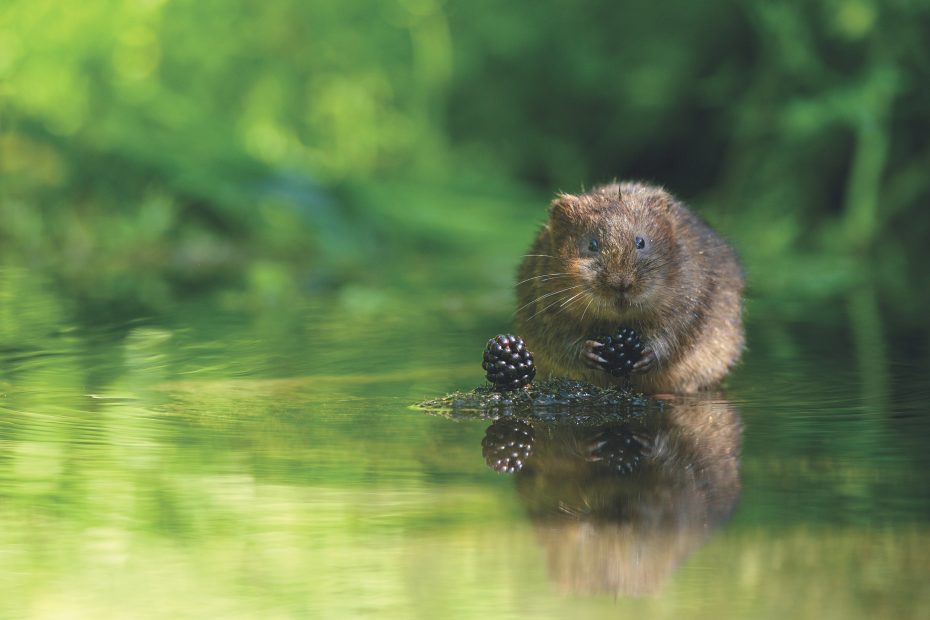
One of my favourite animals to watch was the water rat, or water vole, as its more accurately called. A small burn near where I lived was the place to see them, as well as kingfishers and more. It felt a bit of a secret spot, always alive with surprises.
On one meander I could sit and watch, back against a tree, the comings and goings of the voles as they came out of their labyrinth of holes in the bank and swam through the weed and water like little ‘wirry-gigs’ or miniature beavers. You could hear them chewing their vegetable diet of rushes and flower stems, sat on muddy platforms they treaded outside their homes. They were charming, but also quite irritable with each other and highly defensive of their bit of bankside. I watched, sketched and wrote down their behaviour year on year.
Then, later, as a Countryside Ranger, I watched and fed them apples from my office portacabin, located by an old mill race!
Like so many things we remember from the baseline of wild things we were familiar with in our youth, seeing these lovely creatures is no longer expected and easy. They have been largely lost form our waterways, due to habitat loss, pollution and disturbance and primarily their predation by North American mink, kept by farmers as a side trade in fur farming in the 1950’s, that escaped, were let go and freed occasionally by animal rights people.
The mink, a mustelid, like a polecat or weasel, is a fine and beautiful animal too, but they created a niche that was not there naturally in the ecosystem of the UK. The voles had no defence or relationship with them (unlike say red squirrels and pine martens that can and have always coexisted and evolved in natural balance). The mink swept the voles away and they are still a widespread issue, fragmenting vole populations where they have clung on.
One of the biggest attempts to bring ‘ratty ‘back ever happened a few years ago at the top of the Tyne Valley, in the Kielder watershed. A partnership between Northumberland Wildlife Trust, Forestry England and Tyne Rivers Trust trained volunteers to monitor mink presence and remove them over time. This allowed vole reintroduction into specially prepared habitats. It was and is a success. Taking surplus breeding stock from wild populations in the Borders and the North Pennines a breeding farm was set up and produced 2500 offspring that were introduced through the 5 year Restoring Ratty programme, funded by the National Heritage Lottery. It was a game changer.
I recall the privilege of releasing one specimen. Contained initially in a Pringles tube and carefully held by his tail I lowered him to the water and let go, and off he spiralled through the water, as if he knew exactly where he was going!
These are still doing well and have moved around a bit too, spread out. But not that far. It’s too difficult still for them to re-colonise the Tyne Valley, as we would all like to see, as there are still too many mink about and other threats. Dispersed populations in Durham and Tees Valley, though they’ve dwindled, also remain.
Wouldn’t it be brilliant to reconnect these new and remnant vole clusters into one North East water vole network? It is possible, but it will take a lot of effort and money, it’s a big undertaking taking a big partnership of the willing to make it happen over several years and set up long-term monitoring too.
Wildlife Trusts across the region and other partners and swathes of volunteers are on this now. We are researching and planning towards it, as it has been done in other regions. Can we push the mink to the margins and once more see the water vole as an intrinsic part of our ecology? We saw people’s local support in their generous donations to our Big Give appeal for water voles recently, we know people care.
I really hope it does, as I still can’t believe inside me that these delightful creatures I watched as a child are absent still in large areas of Britian, the most endangered mammal in the UK!
I know a few spots where I can watch ratty, but very few locally. This is a missing link in our Northumbrian fauna. Let’s help it re-establish so future generations can see them and really feel nature is in balance and winning back.